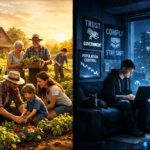
At some point in the last 30 years, American playgrounds stopped being places to climb, fall, and learn, and turned into plastic museums of “risk-free fun.” The monkey bars got lower, the slides got shorter, everything got covered in foam, and someone decided the best childhood is the one where nothing bad ever happens.
And we’re paying for it—with weaker bodies, fragile nerves, and kids who think ordinary life is supposed to feel like walking on padded flooring.
The War on Scraped Knees
Remember metal slides so hot in July they could fry an egg? Remember jumping off the swing at the highest point, just to see if you could stick the landing? Remember the kid who broke his arm once and came to school the next day with a cast like it was a trophy?
Today, that entire universe is basically illegal.
- Monkey bars? Lowered.
- Merry-go-rounds? Removed.
- Seesaws? Liability risk.
- Real climbing structures? Replaced with plastic lumps designed by someone who hates gravity.
We’ve treated every minor childhood injury like a moral failure of the adult world. Instead of a scraped knee being a learning experience, it became Exhibit A in a lawsuit. So the adults did what adults do: they sanitized everything, then congratulated themselves on “keeping kids safe.”
But here’s the uncomfortable truth: those scrapes, bruises, and small scares were the training ground for life.
Risk Is Not the Enemy. Fragility Is.
The modern “safe” playground is built on a fantasy: that you can have growth without risk, courage without fear, and resilience without hardship.
Risk is how kids learn the boundaries of reality.
- You climb higher, your heart races, and you realize your limits.
- You fall, you cry, then you realize pain is survivable.
- You negotiate turn-taking on the slide, and you learn conflict, compromise, and standing up for yourself.
When you remove real risk:
- Kids don’t stop seeking it—they just find dumber ways to get it.
- They develop less judgment because they never practice it on small stakes.
- They learn that the world will always be padded and curated for them.
The result? Kids who are physically weaker, terrified of failure, and emotionally brittle because no one ever trusted them to handle anything.
The Safety Obsession vs. Real Strength
We tell kids:
- Don’t climb too high.
- Don’t run too fast.
- Don’t roughhouse.
- Don’t go out of sight.
- Don’t do anything that might, in any possible universe, result in a bruise.
Then we act shocked when a generation grows up:
- Unable to tolerate discomfort.
- Panicked by uncertainty.
- Demanding trigger warnings for ordinary life.
If you raise kids in a world where everything is padded, they start to expect the rest of life to be padded too. School should be easy. Friendships should never hurt. Work should never be stressful. Everything that feels difficult starts to look like abuse.
That’s not compassion. That’s engineering weakness.
The Playground Was Training for Real Life
The “dangerous” playgrounds of the past were not death traps. They were classrooms.
On the old playground:
- You learned to judge risk: “Can I make this jump?”
- You learned consequence: “If I mess this up, it will hurt.”
- You learned resilience: “It hurt, but I’m fine. I can try again.”
- You learned leadership and hierarchy: “Who dares first? Who backs down?”
Those tiny, physical risks wired kids for bigger, psychological ones later on:
- Trying out for the team.
- Asking someone out.
- Public speaking.
- Moving to a new city.
- Starting a business.
You don’t get people who take bold, calculated risks in adulthood by protecting them from all forms of risk in childhood. You get anxious adults who freeze at every crossroads and outsource decisions to “experts.”
We Confused Protection with Control
Modern playground design looks a lot like modern parenting: control everything, then call it love.
We didn’t just make playgrounds safer; we made them boring. The structures are so idiot-proof that kids can’t invent much. No danger, no real height, no real speed, no real uncertainty. Just… colorful lumps of plastic arranged in safe configurations.
So what do kids do?
- They sit.
- They scroll.
- They whine that they’re bored.
- They go looking for stimulation on screens because the real world has been bubble-wrapped into oblivion.
We thought we were choosing between “danger” and “safety.” Really, we were choosing between:
- Short-term physical risk vs.
- Long-term mental, emotional, and physical fragility.
We picked fragility.
Pain Is a Better Teacher Than a Safety Manual
Nobody wants kids maimed. Nobody is arguing for rebar sticking out of the ground and broken glass under the swings. But the pendulum didn’t just swing toward caution—it swung into paranoia.
We forgot that:
- A broken arm heals.
- A bruised ego recovers.
- Fear passes.
But never learning courage? Never learning resilience? Never learning to trust your own body and judgment? That damage doesn’t show up on an X-ray, but it follows you into adulthood.
The soft, padded, hyper-regulated playground is the built environment version of the participation trophy. No matter what you do, you’ll be fine, someone else has removed the stakes.
And when there are no stakes, there is no growth.
What Stronger Playgrounds Would Look Like
If we actually cared about raising strong kids instead of safe mascots for adult anxiety, we’d design playgrounds with:
- Real height: Structures that are actually a little scary to climb at first.
- Real variety: Ropes, rocks, uneven surfaces, water, and mud.
- Real consequences: You can fall, it will hurt—but not cripple you.
- Real autonomy: Fewer signs, fewer rules, less hovering.
And yes, you’d see more:
- Scraped knees.
- Tears.
- Shaken kids who just did something that scared them.
You’d also see:
- Pride.
- Confidence.
- Toughness.
- Kids leading other kids, not waiting for an adult to referee every tiny conflict.
The Choice We’re Making
Every time we design a new “safer” playground, we’re answering this question—usually without admitting it:
Do we want children who are:
- Slightly more protected from minor injury but unprepared for real life,
or
- Occasionally banged up, but mentally, physically, and emotionally stronger?
Right now, our culture chooses option one. Then it acts confused when those kids grow into adults who crumble under stress, view discomfort as crisis, and expect life to feel like a foam-padded floor.
Playgrounds used to be where kids discovered their courage. Now they’re where we teach them to be afraid of everything that isn’t pre-approved, focus-grouped, and rubber-coated.
Maybe the problem isn’t that kids today are “soft.” Maybe the problem is that we built them a world that never required them to be anything else.